AI Might End the World. Until Then, Stop Using It to Make Posters.
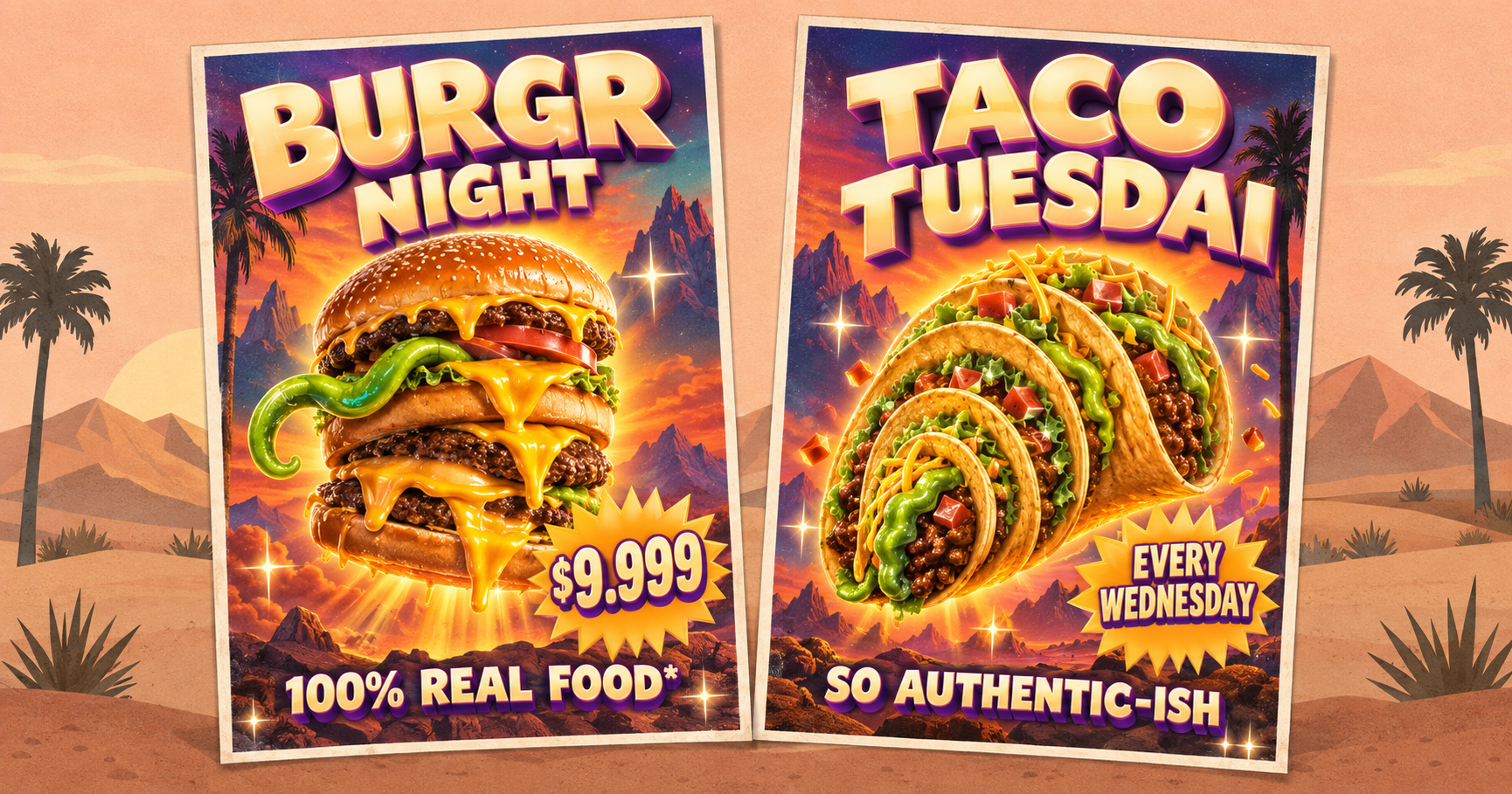
You know the poster. You may have made the poster. Same three colors, same font everyone’s AI tool picked this year, and a plate of food that’s almost food – the tacos have one too many folds, the burger is glowing slightly, and nobody can say what the green thing is. Took about four minutes, and it looks like it took four minutes.
Meanwhile, this week’s news: three researchers at one of the big AI labs went public saying the people building this stuff think it could kill us all by the end of the decade. Not a fringe blog. The Hill covered it, CNBC covered it, serious quotes, the whole thing.
So both of those are true at once. The machines may be coming for us, and in the meantime we’re using them to make the same bad poster over and over. I did mornings on Palm Springs radio for twenty years and I read enough doom out loud at 6 a.m. to know it doesn’t sell anything except the next segment, so I’m going to skip the end of the world and talk about the poster.
(Full disclosure: an AI helped me tidy this post. It did not bring up the end of the world once. Make of that what you will.)
In this article
The poster is the one thing it’s worst at
Just about every business owner I talk to out here has tried AI. And almost all of them tried it on the same job: make the thing people can see. A poster, a social graphic, “write me a caption.” Which is the exact job where it’s weakest and where it shows the most.
The result is a valley full of businesses with the same fake sunset over the same fake mountains that look nothing like the ones out my window, and the same food that isn’t quite food. Your customers can’t say why it feels off. They just scroll past. Ask me how I know – some weeks I get the same poster from three different clients.
Meanwhile the work AI is actually good at is sitting there untouched, because it’s boring and nobody can see it.
The boring stuff is where the money is
Here’s what I use it for on client accounts, and what I’d use it for if I ran a restaurant, a pool company, or a law office in this valley.
Reading your reviews for you. Take the last fifty Google reviews, paste them in, and ask three questions: what do people praise, what do they complain about, and what do they never mention. I’d bet the thing they praise most is something you’ve never once put on your website. That’s a marketing plan, and it took ten minutes.
Turning the PDF menu into a real one. I wrote about this last week. Paste the PDF text in, ask for it as a clean list with prices, paste that into the website. The thing restaurants put off for two years takes an afternoon.
Getting your About page out of your head. Record yourself for three minutes on your phone explaining what you do and why you started. Hand it the transcript. What comes back is a rough draft in your own words, which is more than most About pages can say.
Answering reviews. Not the five-star ones, those are easy. The two-star one from the guy who was mad it was hot in August. Ask it for a draft that’s polite and doesn’t argue, then fix the one sentence that doesn’t sound like you. Done in a minute instead of sitting in your gut for a week.
Cleaning up the customer list. The spreadsheet with five spellings of La Quinta and half the phone numbers missing area codes. It will fix that in one pass. Nobody will ever see it. That’s the point.
Drafting the newsletter you keep not sending. Tell it what happened this month in plain sentences. It gives you a draft. You cut a third of it and hit send.
The rule
If the output is going on a wall or a feed, a human needs to touch it last. If it’s going into a spreadsheet, a draft, or a to-do list, let it run.
That’s the whole rule. The businesses getting real value out of AI right now aren’t the ones with the best posters. They’re the ones with the cleanest customer list, the fastest review replies, and a menu page Google can actually read.
What to do before season
In order of payoff:
- Paste your last fifty reviews in and ask the three questions. Ten minutes. You’ll learn something you didn’t know about your own business.
- Draft a reply to every review you’ve ignored this year. Post them. Reviews with answers rank better and read better.
- Turn your PDF menu, price sheet, or services list into text on the website. If it’s a PDF, Google can’t read it and neither can anyone on a phone.
- Record three minutes about your business and turn it into a page. About page, homepage intro, wherever the current copy was written in 2019.
- Retire the poster template. Pay a human once for something you’ll use all season, or use a real photo of the real thing. A phone picture of your actual patio beats a glowing burger every time.
Highway 111 fills up in about six weeks. Do the boring stuff now while it’s still 105 out and nobody’s looking.
And if the machines do get us in 2029, at least the customer list will be clean.
Casey Dolan runs Casey Dolan Consulting out of La Quinta. He’ll tell you when you don’t need him, which is more often than you’d think. If you want a second opinion on what AI should and shouldn’t be doing for your business, let’s talk.
Share this article

Written by : Casey Dolan
Casey Dolan is a website and digital marketing consultant with 20 years of experience helping businesses, nonprofits, and events make clearer decisions online. He works directly with clients on WordPress websites, SEO, paid media, and practical digital strategy—without the agency runaround.