Hiring a Web Designer? Do These 6 Things Before Your First Call
Most people who reach out to me about a website have never hired a web designer before. That’s not a knock. Why would you have? You started a business to do the thing you’re good at, and somewhere along the way you realized you needed a website (or a much better one) to support it.
After twenty-plus years of doing this for water districts, local publishers, festivals, manufacturers, and a whole lot of small businesses here in the Coachella Valley, I can tell you how most first calls actually go. No examples in mind, no sense of budget, no clear idea of what the site is supposed to do. The conversation turns into a getting-to-know-you session instead of a working meeting. The estimate that follows is a guess, and the project that follows the estimate is where the surprises live.
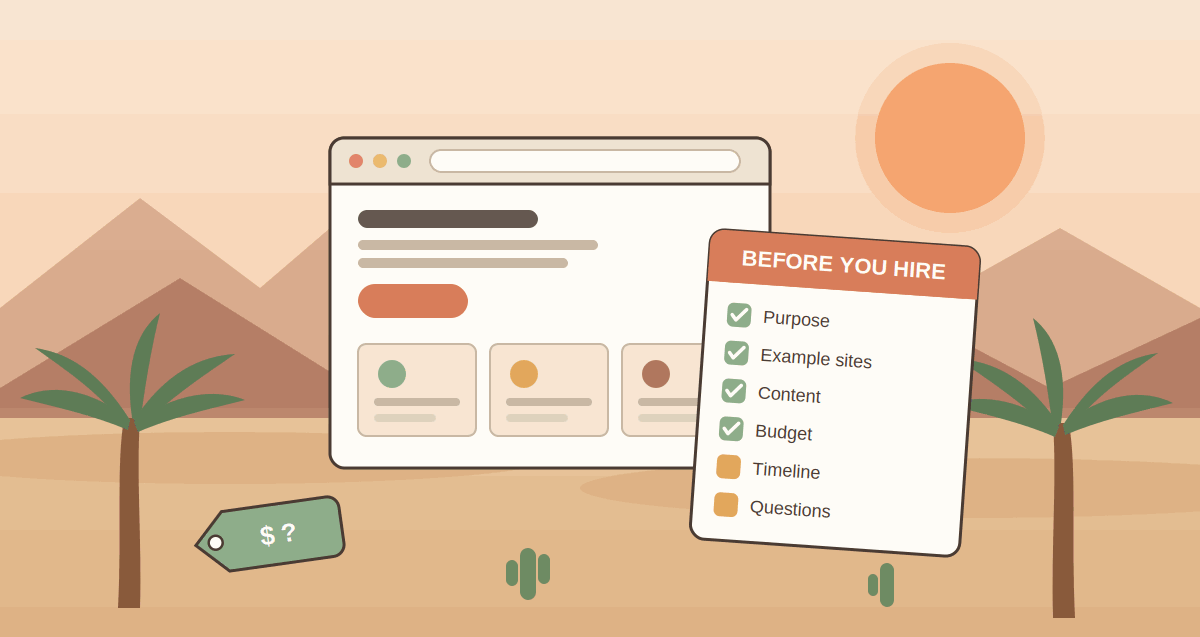
None of that is the client’s fault. Nobody hands you a checklist for this. So here’s mine: the six things I wish every client figured out before the first conversation. It will get you more accurate quotes, let you compare designers fairly, and help you spot a bad fit before you’ve signed anything. Even if you never call me, do this homework and you’ll save yourself real money.
In this article
- 1. Know what your website is actually for
- 2. Collect a few sites you love (and a couple you hate)
- 3. Take stock of your content (this is the #1 project killer)
- 4. Have a real budget range (and know what things cost)
- 5. Be realistic about timing, especially out here
- 6. Know what to ask the designer
- The bottom line
1. Know what your website is actually for
“I need a website” isn’t a goal. It’s a purchase. The goal is what happens after someone lands on the site.
Do you want the phone to ring? Bookings on a calendar? Online sales? Event registrations? Or do you mostly need the site to make you look legitimate when someone Googles you after meeting you at a chamber mixer? All of those are valid, but they lead to very different websites at very different price points. A festival that needs to sell tickets and wrangle vendor applications is a fundamentally different project than a contractor who needs a credible five-page site and a phone number that’s easy to find.
This matters more than you might think. Stanford’s Web Credibility Research found that 75% of people judge a company’s credibility based on its website design. For a lot of your future customers, the site is the first impression, so decide what that first impression needs to accomplish.
Write one sentence: “The main job of my website is to ______.” If you can fill in that blank, you’re ahead of most people who’ve already signed contracts.
2. Collect a few sites you love (and a couple you hate)
Designers aren’t mind readers, and words like “clean,” “modern,” and “professional” mean something different to everyone.
Spend 20 minutes gathering three to five websites you like. Competitors, businesses you admire, even sites from totally unrelated industries. Jot down what you like about each one. The colors? The way it’s organized? How easy it is to find the phone number? Be specific.
Just as useful: one or two sites that make you cringe, and why. “I hate pop-ups” or “this feels cluttered” tells me as much as any inspiration board.
3. Take stock of your content (this is the #1 project killer)
Ask any designer what delays website projects most and you’ll get the same answer: waiting on content from the client. I’ve had builds where the design and development took three weeks and the About page took three months. The site wasn’t late. The words were.
Before you call anyone, take inventory:
- Words. Who’s writing the text for each page? If the answer is “me, eventually,” be honest with yourself about that. Many designers (myself included) can handle the writing or bring in a writer, but it costs more, so you want it in the quote, not discovered in month two.
- Photos. Do you have good, recent photos of your business, your team, your work? Phone snapshots from 2019 rarely hold up next to a fresh design. Professional photography typically runs a few hundred to a couple thousand dollars, and it’s often the best money spent on the whole project.
- Logo and brand files. Your actual logo files, not a screenshot pulled off your Facebook page. Brand colors if you have them. If you don’t, say so up front. Some designers include light branding work and others don’t.
- Logins. Do you know who controls your domain name and current hosting? You’d be surprised how many business owners don’t. I’ve untangled more than one situation where the domain was registered years ago by a designer who has since retired, moved away, or stopped returning emails. Track this down early because it can genuinely stall a launch.
4. Have a real budget range (and know what things cost)
This is the one people avoid, usually because they’re afraid that naming a number means getting charged that number. In practice, the opposite is true. A designer who knows your range can tell you honestly what’s achievable in it, instead of pitching something you can’t afford, or guessing low and nickel-and-diming you later.
I’d rather tell you the truth on the first call, even when the truth is “you don’t need to spend that much.” So you can walk in informed, here’s roughly what the market looks like right now:
- DIY builders (Squarespace, Wix, WordPress.com): roughly $15–$50/month and your own time. A legitimate starting point for some businesses, with real limits.
- Freelance designer or small studio: most small business sites land between $2,000 and $8,000, with more complex or e-commerce projects running $5,000–$15,000+.
- Full agency: typically $10,000–$35,000+ for a small business site.
- Ongoing costs: hosting, domain, and maintenance are never zero. Plan on roughly $50–$200/month for a professionally maintained site, and be suspicious of anyone who never mentions ongoing costs at all.
A quote at the low end isn’t automatically a bargain. It may just mean a template with your logo dropped in. But if you know your comfortable range and what that range usually buys, you can have an honest conversation instead of a poker game.
5. Be realistic about timing, especially out here
Two questions to answer for yourself: Is there a real deadline? And how much time can you personally give this?
The first one matters extra in the desert, where so many businesses live and die by the season. If you need the new site working for you when the snowbirds come back and things pick up in January, we should not be having our first conversation in December. A typical small business site takes anywhere from several weeks to a few months, and the countdown starts when your content is ready, not when you sign.
The second question surprises people. A website project needs you. Content, feedback, approvals. In my experience the schedule slips on the client side far more often than the designer side. If you’re a restaurant heading into season or an event coming up on show week, it may be smarter to build in the summer, when it’s 115° out and the whole valley slows down anyway. Some of my best projects have been summer projects.
6. Know what to ask the designer
Once you’ve done your homework, flip the interview around. A few questions worth asking anyone you talk to, including me:
- Who owns the website when it’s done? The answer should be an unambiguous “you.” Domain, content, and site. (See the untangling story above.)
- What platform will it be built on, and can I update it myself? You shouldn’t have to pay someone every time you fix a typo or change your hours.
- What exactly is included? Copywriting? Photos? Basic SEO? Mobile responsiveness should be a given, but ask.
- What does your process look like, and what do you need from me? A designer with a clear answer here has done this before.
- What happens after launch? Hosting, updates, security, support. Who handles it, and what does it cost?
Vague answers on ownership or ongoing costs are the two biggest red flags in this business. A good designer will welcome every one of these questions. The ones who dodge them are telling you something.
The bottom line
You don’t need to know what a CMS is or have opinions about fonts. You need six things: a purpose, a few examples, an honest content inventory, a budget range, a realistic timeline, and a short list of questions. Bring those to a first call with anyone and you’ll get better proposals, fairer prices, and a website that actually does its job.
And if you’re at the “I know I need something but I’m not sure where to start” stage, that’s a completely normal place to be. It’s exactly the conversation I like having. Get in touch and we’ll figure out the right starting point together. If that turns out to be smaller (or cheaper) than you expected, I’ll be the first to say so.
Share this article

Written by : Casey Dolan
Casey Dolan is a website and digital marketing consultant with 20 years of experience helping businesses, nonprofits, and events make clearer decisions online. He works directly with clients on WordPress websites, SEO, paid media, and practical digital strategy—without the agency runaround.
Related insights

September 10, 2026