SEO in the Age of AI: How Small Businesses Should Position Their Websites in 2026
If you’ve heard someone declare “SEO is dead” lately, congratulations. You’ve witnessed a marketing industry tradition. Right up there with “email is dead” and “websites don’t matter anymore.”
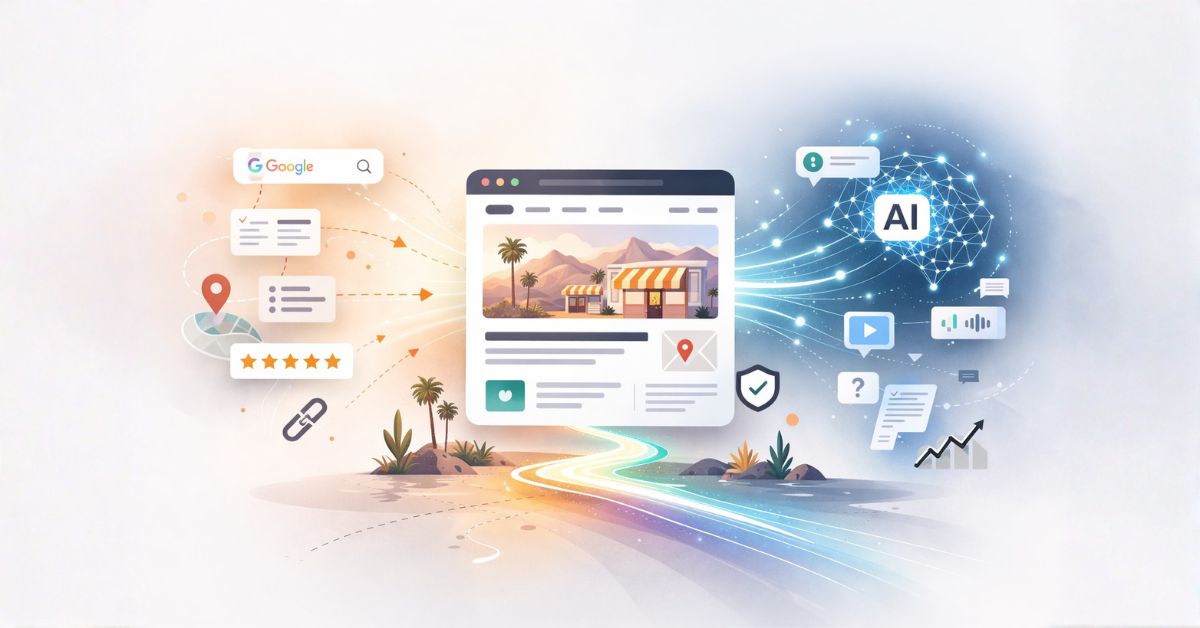
Here’s the truth: SEO isn’t dead. It’s changing. And AI is the reason people are panicking about it. Not because AI “replaced Google” (it didn’t), but because it changed how people get answers and what kind of content actually gets rewarded.
If you run a small business, especially in Palm Springs or anywhere in the Coachella Valley, this matters. You don’t need to chase every shiny new tool, but you do want your website positioned so you show up when people search, ask AI tools for recommendations, or decide who looks legit enough to contact.
In this article
- SEO Didn’t Die. It Got Pickier.
- What AI Search Actually Rewards
- The Good News: Local Businesses Aren’t As Doomed As the Internet Says
- Coachella Valley Reality Check: “Palm Springs” Is Everyone’s Shortcut
- What to Do Now: A Practical Small Business Playbook
- So… Should You Be “Optimizing for AI”?
- One Helpful Reality Check About Content
- A Quick Word on Maintenance (Because It Matters More Now)
- Final Thought
- Frequently Asked Questions About SEO in the Age of AI
SEO Didn’t Die. It Got Pickier.
For a long time, “SEO” was treated like a game of getting Google to notice you. That led to a lot of behavior that technically worked… while also making the internet worse.
Now AI tools are summarizing, comparing, and recommending. Google is also leaning harder into results that feel trustworthy and useful. That means the old tricks and the “write 47 blogs about the same keyword” approach are losing power.
In the age of AI, SEO is less about gaming the system and more about being the obvious, credible answer.
What AI Search Actually Rewards
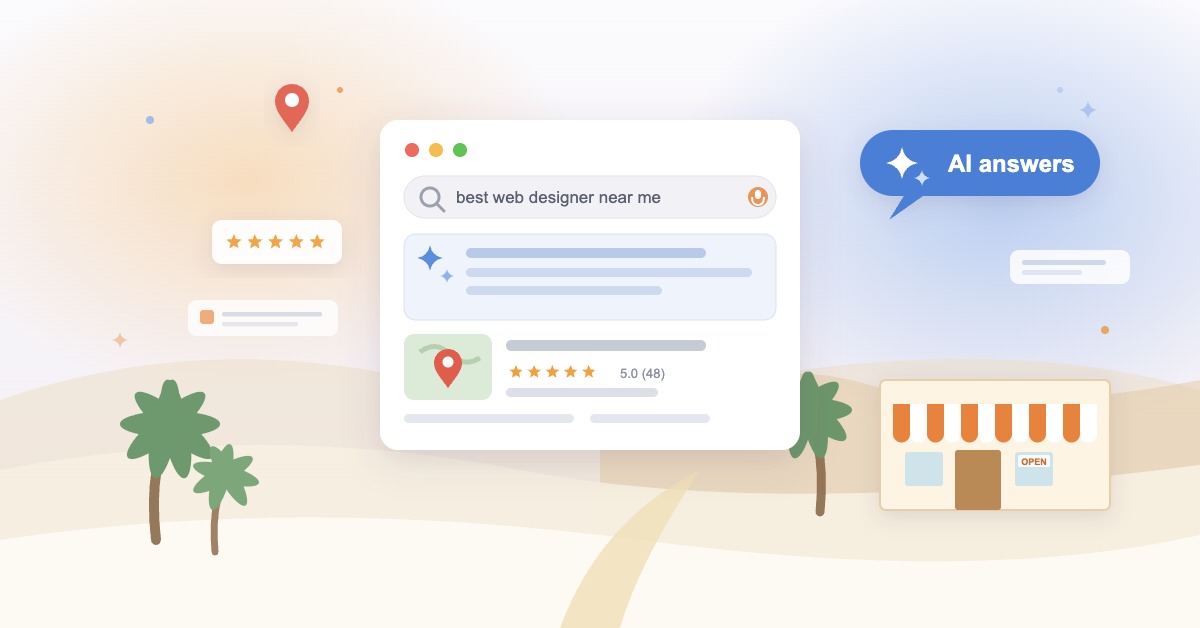
AI tools like ChatGPT don’t “rank” websites the same way Google does, but they do pull from the same universe of signals: clarity, credibility, consistency, and information that looks like it belongs on the internet. (I know. A high bar.)
In practice, AI tends to reward websites that:
- Explain what they do clearly (without making people decode it)
- Answer real questions (FAQ sections still matter, shockingly)
- Have structure (headings, internal links, obvious page hierarchy)
- Show real-world legitimacy (reviews, locations, business info that matches everywhere)
- Stay current (updated services, events, pricing ranges, hours, seasonal info)
The big shift: generic content is getting squeezed. If your content could be written by any business in any city, AI has no reason to pick you.
The Good News: Local Businesses Aren’t As Doomed As the Internet Says
A lot of AI/SEO doom talk comes from publishers who rely on massive traffic volume. If AI answers the question directly, they lose the click. That’s a real problem for them.
For local businesses, it’s different. People still need to:
- Call a real company
- Visit a real location
- Book a real service
- Compare real reviews
- Trust that you actually exist
No one is asking ChatGPT to “repair my AC in Palm Desert today” and then just… sitting with the answer as a fun thought experiment. They still need a business to show up.
Coachella Valley Reality Check: “Palm Springs” Is Everyone’s Shortcut
In the desert, local search is weird in a very predictable way.
Out-of-towners use “Palm Springs” as the umbrella term for basically everything. They’ll search “Palm Springs hotel” while staying in Rancho Mirage. “Palm Springs festival parking” while headed to Indio. “Palm Springs photographer” when the shoot is in La Quinta. It’s not wrong, it’s just how people talk about the area when they’re not from here.
Locals, on the other hand, often search by their actual city or by “near me.”
This is why strong local SEO here usually means two things at once:
- You’re clearly rooted in your primary city (so Google and humans trust you)
- You’re realistically visible across the valley (because your customers don’t search like a map)
What to Do Now: A Practical Small Business Playbook
If you want your site to perform well in the age of AI (and regular old Google), here’s what’s actually worth doing. Not everything. Just the stuff that moves the needle.
1) Make Your Service Pages Ridiculously Clear
Your service pages should answer, within 10 seconds:
- What you do
- Who it’s for
- Where you do it
- What happens next
AI pulls from clarity. Humans convert from clarity. This is the least glamorous part of marketing, which is also why it works.
2) Add FAQs That Sound Like Humans Ask Them
AI loves questions and answers. Google loves questions and answers. People love questions and answers because they don’t have to call you to get basic information.
Use the questions you get in real life:
- “Do you serve Palm Desert too?”
- “How much does this usually cost?”
- “What’s the timeline?”
- “Do I need to do anything before you start?”
Bonus: FAQs reduce junk leads because they help people self-qualify.
3) Treat Your Website as the Source of Truth (Not Your Instagram)
If your website says “check our Instagram for specials,” I’m begging you to stop. Not because I hate fun, but because it creates friction at the worst moment.
Social media gets likes. Websites get customers.
Social is great for staying visible. Your website is where people decide.
4) Tighten Your Local Signals
Local signals are the “are you legit?” layer. In the Coachella Valley, where tourists are constantly filtering businesses fast, this matters a lot.
- Consistent name/address/phone everywhere
- Location and service area stated clearly
- Real photos (not just stock images)
- Reviews that mention services and locations naturally
Speaking of which…
5) Google Business Profile Still Matters More Than People Want It To
Google Business Profile isn’t glamorous, but it is brutally influential. In many local searches, it’s the first impression and the decision point.
Keep it current. Add photos. Respond to reviews. Post updates occasionally. Make sure your categories and services are accurate.
AI tools may not “read” your GBP like a human, but the broader web ecosystem absolutely uses those signals.
So… Should You Be “Optimizing for AI”?
Sort of. But not in the way people are selling it.
You don’t need a separate “AI SEO strategy” if you do the fundamentals well. Most “AI optimization” advice is just good SEO with a trendy outfit on.
Here’s the real play:
- Be clear. Don’t hide what you do behind clever language.
- Be structured. Use headings, internal links, FAQs, clean page organization.
- Be credible. Reviews, proof, consistency, real information.
- Be current. If your pricing, services, or staff changed three years ago, update the site.
One Helpful Reality Check About Content
AI has made it easy to produce content. That also means the internet is now flooded with content that exists for no reason.
Your advantage as a real business is this: you have real experience in a real place with real customers.
That’s what your content should sound like.
If you’re in Palm Springs, say things that only make sense in Palm Springs. Mention seasonality. Mention tourist behavior. Mention local landmarks or common questions you get from people staying in town. Not as fluff. As context.
Because in the age of AI, specificity is a competitive advantage.
A Quick Word on Maintenance (Because It Matters More Now)
AI and search engines don’t love broken websites. Neither do humans. Keeping WordPress updated, running security checks, maintaining backups, and staying on top of performance issues protects your rankings and your reputation.
If keeping up with updates isn’t your favorite part of running a business (understandable), that’s where ongoing website management helps. It’s cheaper than cleanup, and it prevents the “why is our site suddenly selling sketchy pharmaceuticals?” scenario.
Final Thought
SEO in the age of AI is not about chasing hacks. It’s about earning the right to be recommended.
When your website is clear, structured, current, and locally credible, you don’t have to fear AI. You benefit from it.
And if your marketing still assumes it’s 2016, don’t panic. Just update the strategy. Preferably before the internet updates it for you.
Frequently Asked Questions About SEO in the Age of AI
Is SEO dead because of AI?
No. SEO is evolving, not disappearing. AI tools change how answers are presented, but search engines still rely on structured, credible websites. Clear service pages, local signals, and strong authority matter more than ever.
Should small businesses optimize specifically for AI tools like ChatGPT?
You don’t need a separate “AI strategy.” If your website is clear, well-structured, locally relevant, and regularly updated, you’re already positioning yourself well for both traditional search and AI-driven summaries.
Does local SEO still matter in places like Palm Springs and the Coachella Valley?
Yes. Local intent remains strong. People still search for services “near me” or by city name. AI does not replace the need for businesses to show up in local results, map listings, and trusted directories.
Will AI reduce website traffic for small businesses?
It may reduce low-quality informational clicks, but high-intent searches still lead people to real businesses. For service-based companies, clarity and credibility are more important than raw traffic volume.
What is the most important thing to focus on right now?
Clarity. Make sure your website clearly explains what you do, who you serve, and where you operate. Add FAQs, keep your information current, and maintain strong local signals across your website and Google Business Profile.
Share this article

Written by : Casey Dolan
Casey Dolan is a website and digital marketing consultant with 20 years of experience helping businesses, nonprofits, and events make clearer decisions online. He works directly with clients on WordPress websites, SEO, paid media, and practical digital strategy—without the agency runaround.